If not for the compulsions of engineers, mankind would never have seen the wheel, settling instead for the trapezoid because some Neanderthal in marketing convinced everybody it had great braking ability.
–Scott Adams, Creator of the Dilbert comic strip
On my road trip to South Africa’s West Coast in April this year, I took a private boat cruise up the Berg River. As we passed under a bridge, the captain informed us that it supported a vital railway: the Sishen–Saldanha line (also known as the Iron Ore Export Line).

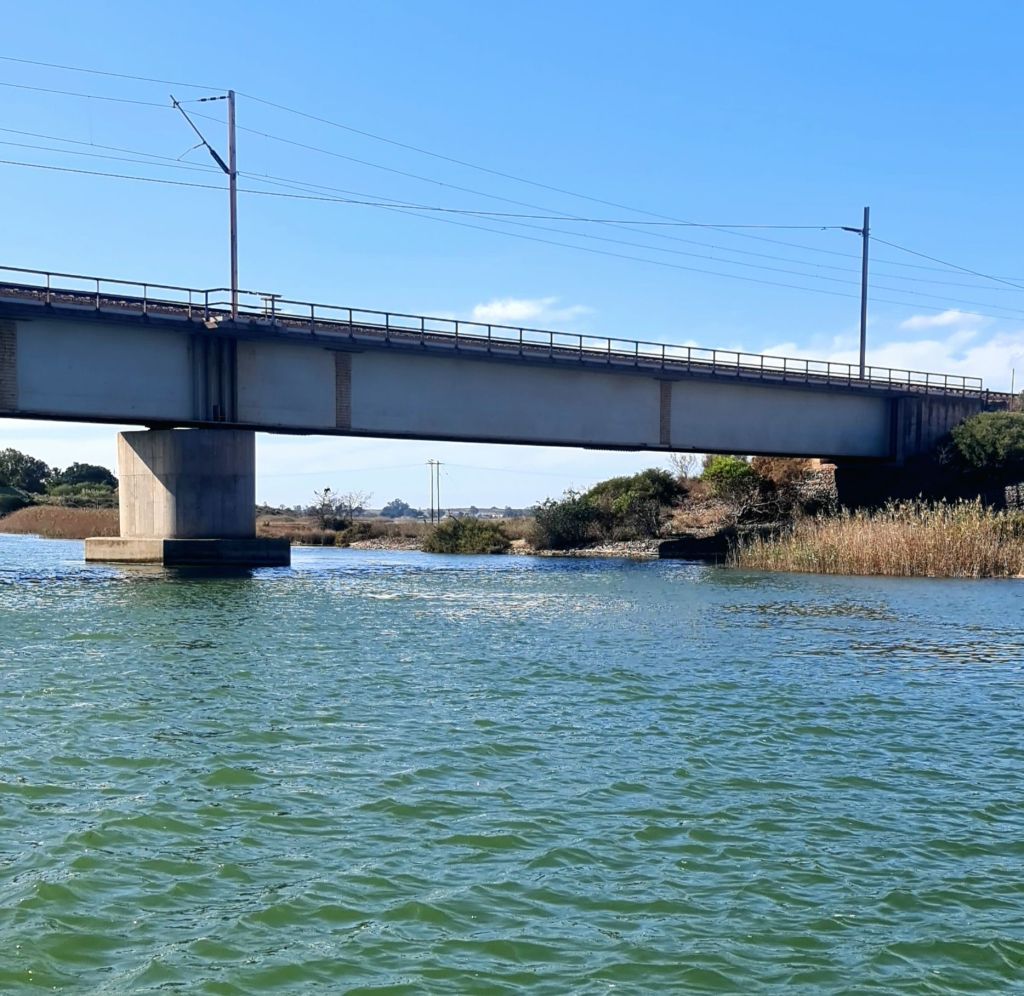
These are some shots I captured on the cruise. You might be wondering what in the world a boat, a bridge, and a railway line have to do with a world record. Well, really, only the latter two matter.
The Iron Ore Export Line is an 861-kilometre heavy-haul rail corridor that directly connects the iron ore mines in Sishen in the Northern Cape to the Port of Saldanha in the Western Cape. In 1989, South Africa’s public rail operator, Transnet Freight Rail (TFR), set a world record by running the longest train on that line.
However, in 2001, BHP Iron Ore beat that record by running a train with 682 loaded wagons across Western Australia’s Pilbara region. The train had eight GE AC6000CW locomotives pulling wagons 7.35 kilometres long, with a gross weight approaching 100,000 tonnes.
I just learned that a few days ago, on October 18, TFR set a new freight rail record by successfully operating a 696-wagon empty train, 7.6 kilometres long, on the same Sishen-Saldanha line. The train was hauled by a combination of 15E electric and 43DE diesel-electric locomotives, strategically positioned along the train’s length.
The wagons were configured using a Radio Distributed Power (RDP) arrangement. This technology lets the train operate as one synchronised unit, distributing locomotive power and braking forces throughout the train. You can find pictures of the train in this online BUSINESSTECH publication.
I’m truly chuffed that this expertise is still available in South Africa despite our crumbling rail network. Despite studying both mechanical and electrical engineering, I’m flabbergasted that, after all these years, I haven’t bothered to find out how a locomotive can pull so much weight. Learning never ends, and so I had to put that maxim to the test.
Fortunately, YouTube can be a valuable learning resource if you can avoid the mountains of AI slop and eye candy created to confirm your biases. It turns out the system that lets locomotives haul so much dead weight is not only ingenious, it’s completely bonkers.
Turns out, those locomotives don’t do all the heavy lifting: it’s all about those couplers that connect the freight cars. I couldn’t explain it easily in layman’s terms, so here’s a video that does.
Hope you enjoyed it as much as I did.






Please leave a comment or reply