It says something about a sense, I suppose for me personally, a sense that I may have betrayed him. He died in the last war and I kind of feel that I personally may have betrayed him, because we haven’t managed to improve things very much. That the economic cycles still over-ride everything, with the best intentions, the cycle of economic recession followed by resurgence still governs our actions.
–Roger Waters (talking about feeling personally responsible for his father’s betrayal)
While Pink Floyd produced highly-rated classics such as The Wall, The Dark Side of the Moon, Wish You Were Here, and Animals, The Final Cut is still my favourite album – even as you will later learn, one band member tried to disown it.1
This contrarian preference may cause a few hairs to bristle, but I have several good reasons for liking the album frequently regarded as the one that finally broke up the band for good. Even the band members agree that during the production of The Final Cut, their 12th studio album, friction between them had reached a crescendo. The name of the album is therefore about as appropriate as you can get.
Acrimony between band members started manifesting more prominently during the production of The Wall, and by the time The Final Cut came around, keyboardist Richard Wright had already been fired. Roger Waters had assumed almost total creative control, and it showed in this album, which contained many songs which didn’t make it onto The Wall.
Many, both at the time and afterwards, would accuse Roger Waters of turning the album into his own pet project. It is sometimes actually regarded as a de facto solo album. David Gilmour didn’t appreciate the political stance Waters was trying to evoke in the recording. He even removed his name from the credits list as producer, although he has continued to receive production royalties.
(In case you’re wondering if I have some sort of animosity toward David Gilmour, I don’t. I regard him as one of the best and most influential guitarists in the world. And he was instrumental in getting one of my favourite female artists, Kate Bush’s career, into motion)
Having gotten all the unpleasant, acrimonious bullshit out of the way, it brings me to the two top reasons for loving this album so much.
Firstly, Waters is a creative writing genius. So much of Pink Floyd wouldn’t exist without him. I applaud him for taking creative control to produce an artistic work with significant political and humanitarian significance. Had Gilmour had his way, this album might not have seen the light of day.
Secondly, The Final Cut is a magnificent political statement and work of activism. It is an anti-war album. That in itself places it in very high esteem because it mirrors my own extreme distaste for war and warmongering. Waters would go on to have a highly successful solo music career, creating many albums that exemplify his humanity and activism work. It infuriates me greatly that he is frequently accused of antisemitism for merely pointing out the egregious injustices inflicted on the Palestinian population by Israel.
Waters wrote the songs in memory of, and in tribute to, his father, who died during WWII, but also to all the other soldiers who gave their lives in vain for the unrealised dream of a better, more peaceful world. Much of his writing since then still reflects his disappointment with a world plagued by a continuous stream of wars and warmongering as a preferred means of solving problems.
Then there are the songs themselves, each with lyrics that have very deep meaning, targeting specific events and people.
In The Post War Dream, we have the following lines which question what his father sacrificed his life for:
Tell me true, tell me why, was Jesus crucified?
Was it for this that Daddy died?
Was it you, was it me?
Did I watch too much TV?
Is that a hint of accusation in your eyes?
Also, in The Gunner’s Dream, Waters imagines an airman as he is shot down and descending, dreaming of a peaceful, just world free from tyranny, state terror, and the slaughter of children:
A place to stay, enough to eat
Somewhere, old heroes shuffle safely down the street
Where you can speak out loud about your doubts and fears
And what’s more, no one ever disappears
You never hear their standard issue kicking in your door
You can relax on both sides of the tracks
And maniacs don’t blow holes in bandsmen by remote control
And everyone has recourse to the law
And no one kills the children anymore
No one kills the children anymore…
Similar themes are explored in the other songs. In The Fletcher Memorial Home, as well as a few other songs, Former British Prime Minister Margaret Thatcher, who was in office when the album was produced, comes in for particular stick. It is my favourite song on the album, and definitely one of my top five Pink Floyd songs.
In the song, Waters envisioned a special retirement home where the world’s political leaders, tyrants, and warmongers would be safely locked up and deterred from perpetrating any further harm to society.
Take all your overgrown infants away somewhere
And build them a home
A little place of their own
The Fletcher Memorial Home For Incurable Tyrants and Kings
They could appear to themselves every day
On closed-circuit TV
To make sure they’re still real
It’s the only connection they feel
(And now, adding colour)
(“Who’s the bald chap?”)
(A group of anonymous Latin-American meat packing glitterati)
Did they expect us to treat them with any respect?
Safe in the permanent gaze of a cold glass eye
Their favourite toy
They’ll be good girls and boys
In the Fletcher Memorial Home for Colonial Wasters of Life and Limb
Is everyone in?
Are you having a nice time? (Goodbye!)
Now the final solution can be applied
This song perhaps exposes a personal vindictive streak, hopefully the only one I harbour. I too wish for the so-called leaders of the world from North and South America, Europe, Africa, India and other countries we do not hear about all that often, to be incarcerated, not in a cosy retirement home, but in some sort of hard-labour concentration camp.
But would I want the final solution to be applied as Waters recommends in the song?
Perhaps! I might be tempted…
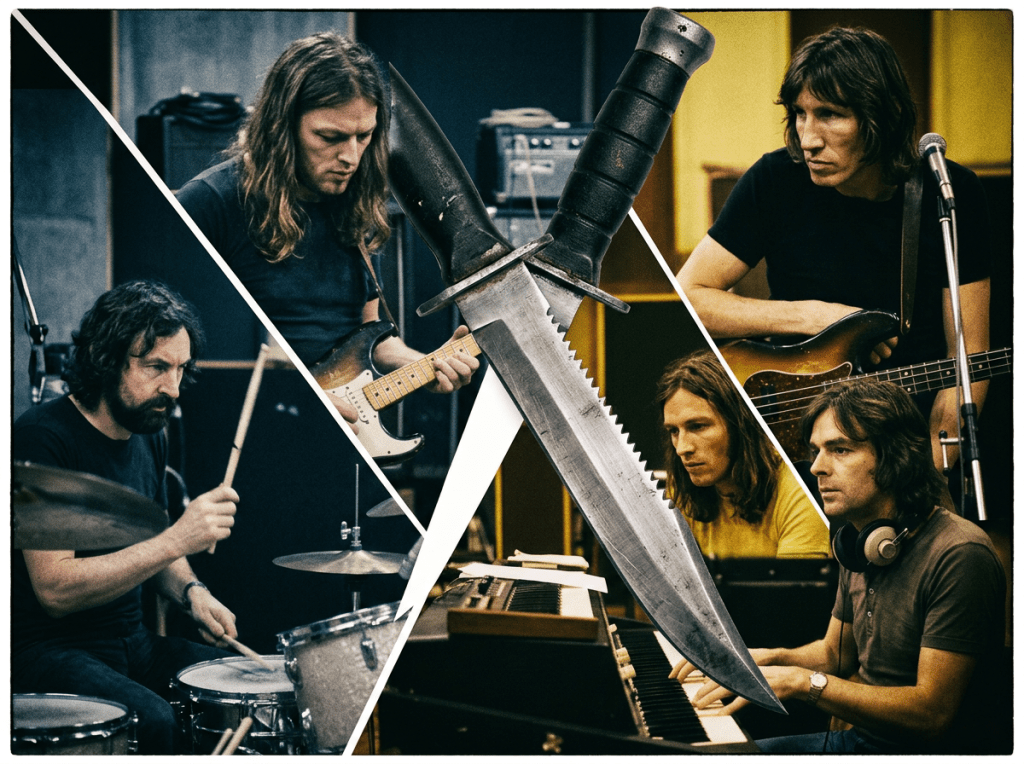
- Featured image of the band is AI-generated ↩︎







Please leave a comment or reply