
It is useless to attempt to reason a man out of a thing he was never reasoned into.
– Jonathan Swift (attributed)
Here’s the thing! I’m about to advise you not to do something I have been regularly indulging in. Having lots of time at my disposal, I developed an admittedly nasty penchant for responding to the blatant bigotry in the comments sections of various social media platforms.
You can hate me later, but first let me tell you why I’ve decided to come clean about it. It’s not just the barefaced ignorance of recorded history, wilful misunderstanding and perversion of current events, debasement of civil norms, disingenuity, and rank hypocrisy of the social commentators. Worse, it’s the (mis)appropriation of divine authority (why is it almost always the Christians?), and the sheer inhumanity, entitlement, and complete lack of awareness that incenses me.
I have, unfortunately, developed a habit of making screen prints on my mobile device of exchanges with complete strangers on social media because of the distasteful practice of some who, having been called out or chastised, delete their comments. Here is an example of just one such comment made in response to an article by a local online newspaper, bemoaning the bombing of Palestinian schoolchildren in Gaza:

There were so many others, most excusing or justifying the Israeli bombing, closing ranks around the depraved Israeli soldiers and nation, while cold-heartedly ignoring the object of the article itself. My comment, as it usually does, generated a heap of nasty responses and, of course, the obligatory insults.

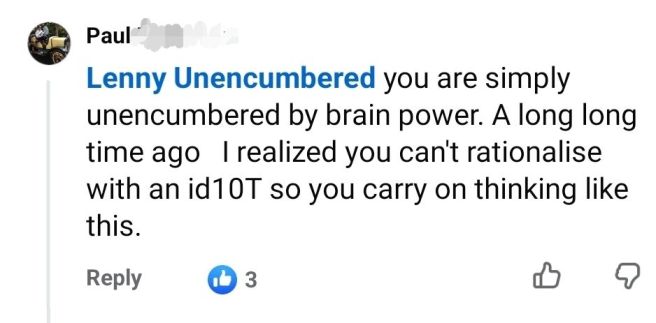
Of course, my antagonist had to double down on his position when I challenged both his insult and his uneducated approach to reasoning.
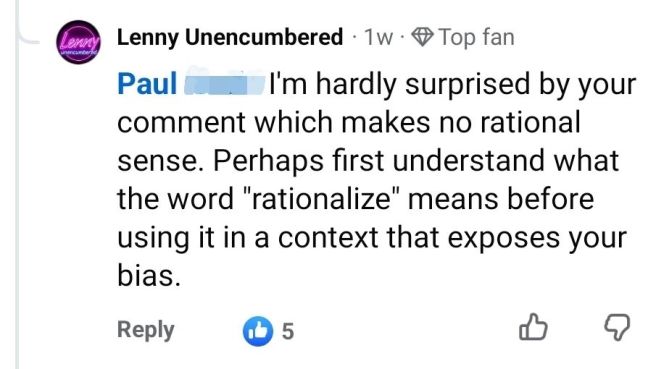

My parting response remains unanswered. Maybe he finally figured it out, but perhaps that’s too much to hope for. The subtleties of the English language were furthest from Paul’s mind. Paul’s intention was to ridicule, insult and score brownie points with like-minded online commentators who frequently use laugh emojis among others to buttress their argument, or lack of it.

While I’m not particularly proud of my final response, it does lead to the main reason for this post. It’s not the first time I’ve encountered someone who does not understand the difference between reasoning and rationalising.
Reasoning is the objective process of using logic and evidence to discover the truth. Rationalising, however, is a psychological defense mechanism where you start with a preconceived conclusion or emotional bias, and work backward to invent superficially plausible justifications to defend it.
Paul had already rationalised his support for Israel and their military campaign in Gaza. He had convinced himself that his rationalisations were sound. Arguing with him online was bound to fail. Writing in the Blog of the American Philosophical Association, Isaac Wiegman provides reasons why arguments almost never work.
Wiegman writes about our inclination for defensiveness and motivated reasoning, and draws on The Scout Mindset, a book by Julia Galef, who hosted Rationally Speaking, a podcast I used to follow more than a decade ago, before podcasts became so widely popular. Julia distinguishes between thoughtful reasoning, which she calls the Scout Mindset and motivated reasoning, which she calls Soldier Mindset. She outlines six broad categories that a soldier mindset defends as follows:
Comfort: We shield ourselves from unpleasant emotions. If you have invested time and energy in convincing yourself and others of something (e.g., that the earth is flat or not, that global warming is a threat or not, that abortion is okay or not), you will avoid evidence to the contrary because you want to avoid the shame, embarrassment, or dissonance that would go along with admitting you were wrong.
Self-esteem: We enhance or protect our self-image. If you are wealthy, you might ignore or discount evidence of systemic injustice or inequality. At some level, you want to maintain the belief that you earned what you got within a just and equitable system. If you are relatively poor, you’ll think the opposite and blame bad luck for your setbacks.
Morale: We fight to preserve our motivations and expectations. If you are committed to a new business idea, you might avoid evidence that it could fail. You want to protect your motivation to give it your best shot, holding on to your expectation that your hard work will pay off.
Persuasion: We defend our ability to convince others. If you’re in the middle of a messy divorce or court battle, you might fiercely deny your adversary’s claims, however reasonable. You want to stay convinced of the righteousness of your cause so that you can be convincing to others.
Image: We shield our reputation. If someone accuses you of plagiarism, you may look for all kinds of reasons why your uncited use of a source was excusable. As in the case of René Diekstra.
Belonging: We protect our place of belonging in social groups. If your belief in God is required for membership and belonging in a community of faith (or required to keep your job in it), then you may tend to avoid evidence that God might not exist.
Given the outlined futility of unstructured online argumentation, it remains to be seen whether I will, in the future, resist the urge to engage with those who demonstrate blatant bigotry. The mindfulness required could well be the deterrent.







 lenny unencumbered
Please leave a comment or reply