
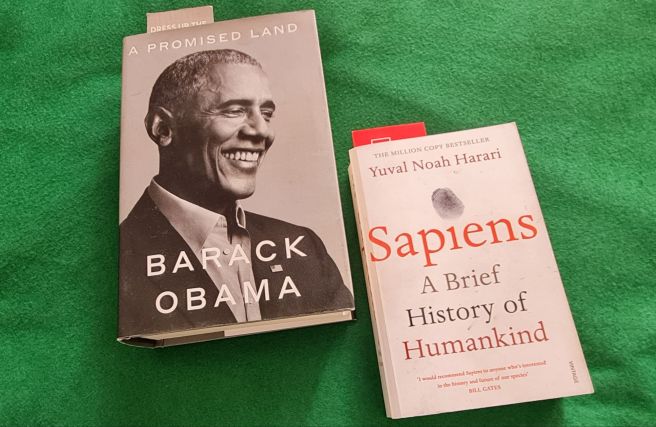
Although many half-read books are languishing on my bookshelves in lethargic purgatory, I have never wholly abandoned any book before out of sheer disenchantment. These two titles I’m about to discuss have earned that dubious distinction.
Sapiens – A Brief History of Humankind
The English version of Sapiens has been around since 2014, but I only bought into the hype about two years ago. Bill Gates, co-founder of Microsoft, recommended it on the front cover to “… anyone interested in the history and future of our species.” Barack Obama, former US President and the subject of the other book in this essay, quipped that it was “Interesting and provocative… it gives you a sense of perspective on how briefly we’ve been on this Earth.”
Also, the publicity blurb on the back cover added, “This is the thrilling account of our extraordinary history – from insignificant apes to rulers of the world.” It all sounded very intriguing.
I was sold!
Just over two hundred pages in, my interest had not wavered. The division of history into (1) The Cognitive Revolution, (2) The Agricultural Revolution, (3) The Unification of Humankind and (4) The Scientific Revolution, intermingling the natural sciences with the social sciences, all seemed exciting and plausible.
Until I got to the chapter where Harari attempted to rationalize and justify imperialism and colonialism as “It’s for Your Own Good.”

For context, it’s necessary to reveal that I was reading the book during an unfolding genocide in the Middle East. All the while, the uber-imperialist USA was actively funding the intense bombing and allegedly manipulating a wider conflict. My initial shock turned to disgust when Harari asked the following seemingly innocuous and rhetorical question to justify his stance.
How many Indians today would want to call a vote to divest themselves of democracy, English, the railway network, the legal system, cricket and tea on the grounds that they are imperial legacies?
It’s the kind of contemptuous unawareness only a colonizer who’s never faced injustice can conjure up. Naturally, I stopped reading at the end of the chapter to learn more about the author and his intentions.
Soon after, I decided to consign the publication to collect dust because I’m not the book-burning kind. I had been duped.
While populists and celebrities like Gates, Obama and Zuckerberg gave the book an unsurprisingly warm reception, scholars, academics and scientists have not been so kind. Neuroscientist Darshana Narayanan wrote an article in Current Affairs magazine titled The Dangerous Populist Science of Yuval Noah Harari. She was scathing:
The best-selling author is a gifted storyteller and popular speaker. But he sacrifices science for sensationalism, and his work is riddled with errors.
Anthropologist Christopher Robert Hallpike was similarly scathing when he reviewed the book, suggesting that he did not find any “serious contribution to knowledge”. He declared that “…whenever his facts are broadly correct, they are not new, and whenever he tries to strike out on his own, he often gets things wrong, sometimes seriously.”
While he’s a vocal critic of Israeli President Benjamin Netanyahu and the right-wing government of Israel, perhaps the thing I found most disconcerting about Yuval Noah Harari was his defence of Zionism and his apparent indifference to the plight of the Palestinian people.
In a scorching rebuke of Harari’s defence of Zionism, Israeli/American activist, photographer, and writer Yoav Litvin summed him up perfectly in an article he wrote for The New Arab, entitled Yuval Noah Harari’s Odyssey into a Parallel Zionist Universe:
Pseudo-intellectual idol to the masses, Yuval Noah Harari’s imaginary Zionism is so far-fetched he may as well be living on another planet.
A Promised Land
Obama’s memoir was released just weeks after the 2020 US presidential elections. The timing of the release was probably carefully planned because the country had just endured four years of a torturous Trump presidency and was ripe for some Obama nostalgia.
As a foreigner who had observed the Trump train wreck from the safety of my armchair with much bemusement, I must admit that I, too, got caught up in the sentimentality. Therefore, I plumped for the hardcover version, thinking it would not only look great on the coffee table but would be one to adorn the bookshelf for keeps.
As with most new books I buy, I don’t start reading immediately as I usually have two or three books on rotation which I need to finish first. If I remember correctly, I only started reading A Promised Land months later.
Honestly, it was slow going. I was still plodding through it until I finally abandoned it around December last year. That’s around the time when all my illusions about the USA were shattered.
The reason for the slow progress up to that point was that I found Obama’s detailed descriptions of the minutia around his political life and presidential campaigning to be somewhat ponderous. Frankly, it was tedious and was written for political hacks who find that type of thing fascinating.
Given America’s complicity in the unfolding genocide in Gaza and the multitude of revelations about their imperialist pedigree, it also became apparent shortly after October last year that Obama’s eight years in office were not only duplicitous but helped strengthen US hegemony.
The admiration I once held for America’s first Black president and the euphoria had turned into deep disappointment and distaste.
I have since learned that Obama’s pick of Joe Biden as vice president was probably more calculated and strategic than we have been led to believe. It turns out that Obama might not have won the presidential race if he had not had a reassuring White figure by his side who would appease a significant portion of the electorate. Biden’s hardline attitudes, which he is so revoltingly demonstrating today, were apparently well-known back then. Those qualities helped Obama win over a particular segment of the electorate.
In hindsight, awarding the Nobel Peace Prize to Obama was an egregious mistake and a humongous finger to peace and humanitarian standards. During his tenure in office, Obama authorized 542 drone strikes that killed an estimated 3,797 people, including 324 civilians. Mark Halperin and John Heilemann alleged in their 2012 book Double Down that Obama told senior aids in 2011:
Turns out I’m really good at killing people. Didn’t know that was gonna be a strong suit of mine
Celebrated author Chimamanda Ngozi Adichie was restrained yet generous in her praise for Obama’s memoir. She lauded his “wholesome humanity.” I think she’s deeply mistaken. Notwithstanding all the praise A Promised Land received, I, for one, will not rush to pick up a copy of the promised second volume of the memoir.
Unless, of course, Obama comes clean and exposes his role in perpetuating both imperialism and Empire. Somehow, I don’t expect that to happen.
 lenny unencumbered