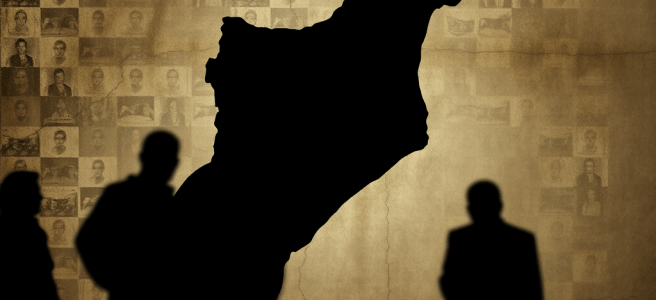
If genocide is ultimately an act of erasure, denial is its final, comprehensive deed.
–Serj Tankian, System of a Down

As global awareness of the atrocities being committed by Israel in Gaza and the West Bank intensifies, there is still widespread denial of a genocide being committed.
This denial persists even though there is a growing consensus and broad acknowledgement by practically every humanitarian and human rights organisation, including The Lemkin Institute, Amnesty International, Human Rights Watch, and Israeli NGO’s like B’Tselem and Physicians for Human Rights-Israel. Acknowledgement of Israel committing genocide is not limited to humanitarian organisations, though.
Recognition also comes from academics, scholars and genocide experts like Martin Shaw, Raz Segal and Omer Bartov (both Israeli), and legal experts like the United Nations Special Rapporteur on the occupied Palestinian territories, Francesca Albanese. Meanwhile, politicians like former Israeli Minister of Defence, Moshe Yaalon, and former Israeli Prime Minister Ehud Olmert concede that war crimes are being committed. Still, it won’t be long before they’re obliged to either take the next moral step or be blackmailed into recanting by the Israeli security establishment.
At the end of last month, 86% of the members of the International Association of Genocide Scholars (IAGS) passed a resolution stating that “policies and actions in Gaza meet the legal definition of genocide.” Onur Uraz, chair of the IAGS Resolutions Committee, confirmed that the resolutions support numerous United Nations and Non-Governmental Organisation reports. This will no doubt bolster the South African case brought before the International Court of Justice (ICJ) against Israel, which last year found that there is a plausible case of genocide occurring against the Palestinians.
A recent exposé by Ryan Grim of Drop Site News on Substack confirms that Israel is widely considered a “genocidal, apartheid country” by research Israel itself commissioned. Preliminary reports by Stagwell Global, the US company appointed by the Israeli Ministry of Foreign Affairs, to conduct polls, surveys and focus groups in the United States, Germany, the United Kingdom, Spain, and France, paint a very negative picture of Israel’s image abroad.
While I regularly experience vociferous genocide denial here in my interactions with fellow South Africans, I am also disconcerted by discernible apathy from family and friends, some of whom are undoubtedly influenced by their religious affiliations. Evangelical Christian doctrine clearly champions Zionism and, by extension, a hypocritical support for the State of Israel, while turning a blind eye to its depraved, oppressive policies.
Apart from the genocide denial, I frequently encounter apologists for Israel whose ignorance of recorded history is breathtaking. For them, there is no context to October 7th. It is branded in their memory as a starting point for the vicious Israeli military onslaught on Gaza and subsequent annihilation of the Palestinian people. Many among them are also firmly of the belief that the depravity being unleashed on the population of Gaza, including tens of thousands of children, is justified.
Below are examples of some of the revolting responses I have received on news media comments columns from South Africans.
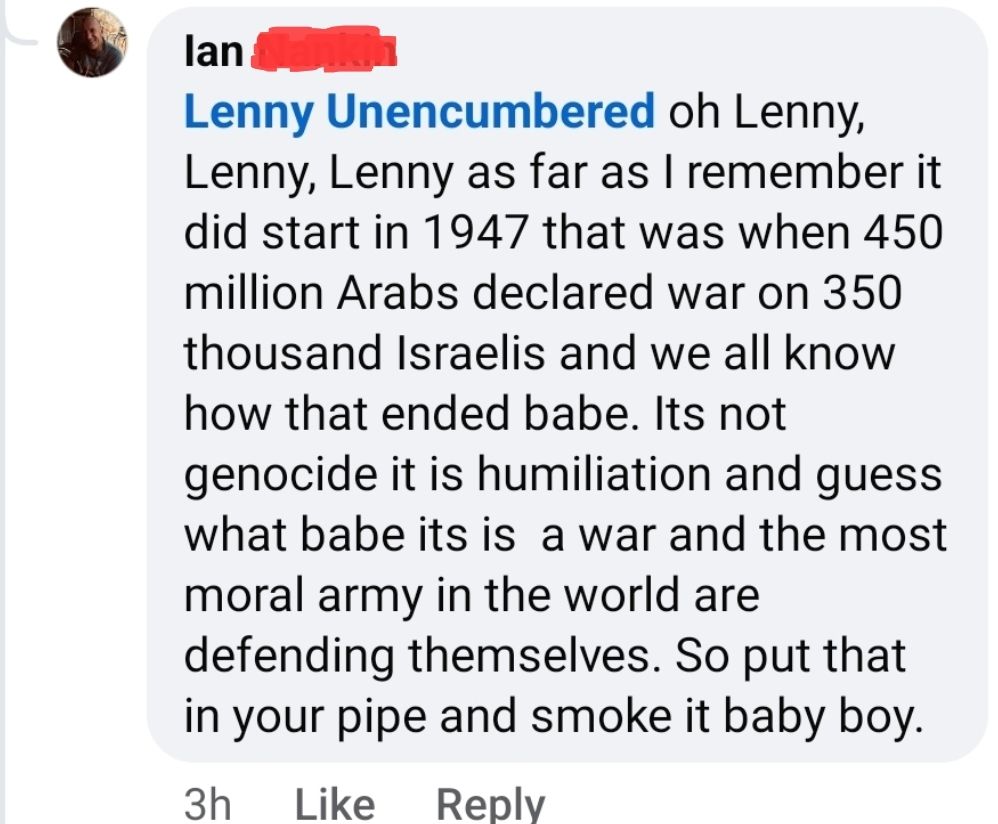

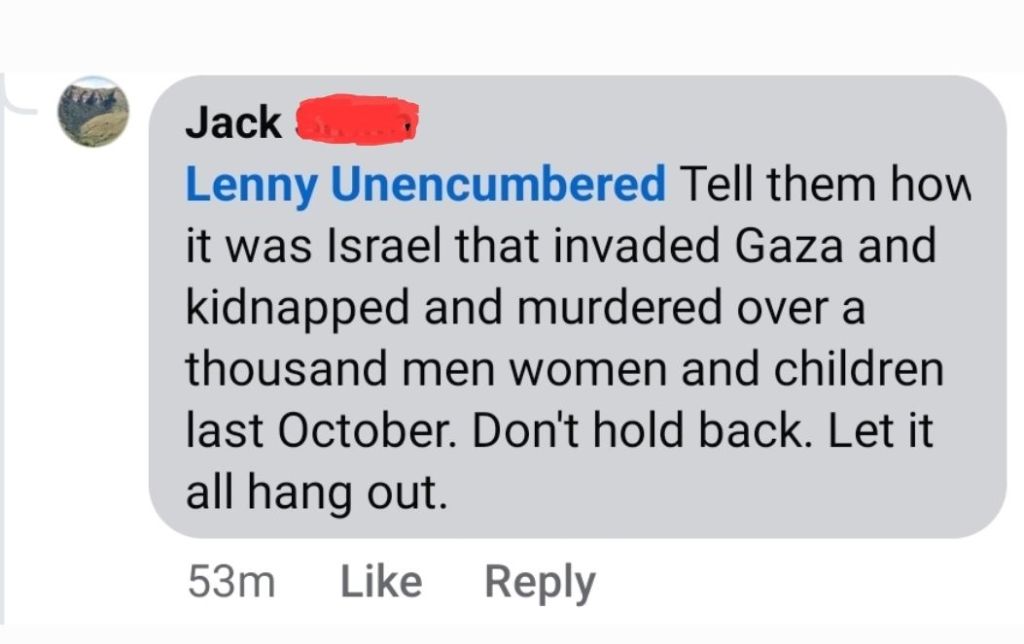

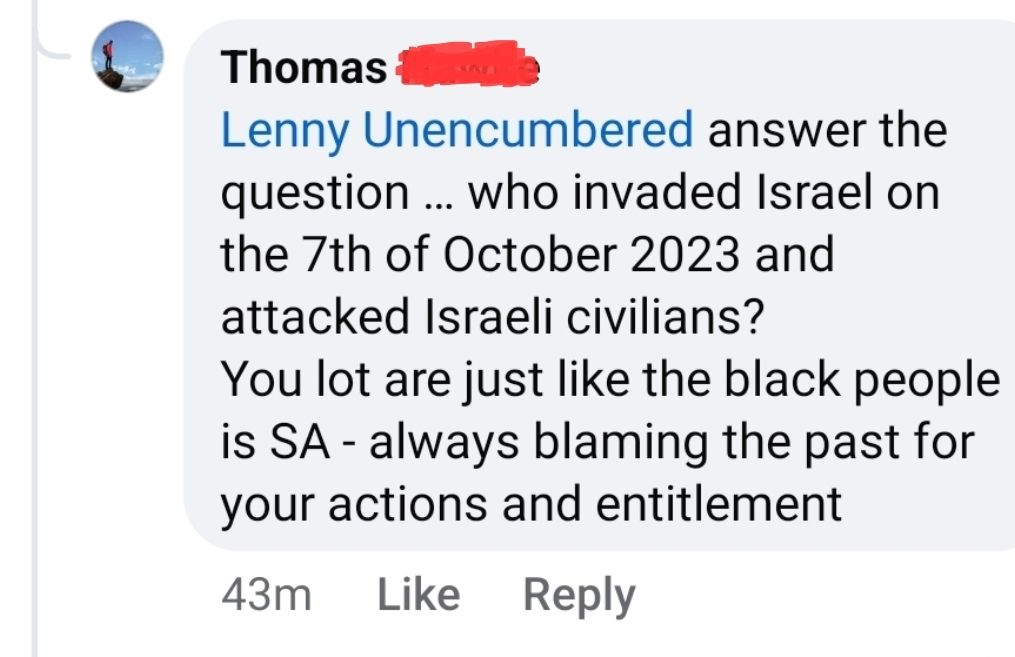
The Israeli propaganda machinery has been very successful in smearing Hamas as a violent terrorist organisation. Several Israeli politicians have gone so far as to claim that every single Palestinian is a Hamas operative, including children. That narrative has found favour with many of Israel’s apologists, so it’s not hard to see why they can turn a blind eye to the mass slaughter of so many children. Israel’s supporters clearly won’t appreciate the depth of truth in this quote, which I picked up from somewhere:
Hamas didn’t start the conflict; the conflict started Hamas.
When Polish lawyer Raphael Lemkin coined the term genocide, his definition implied that it was a continuum or pattern of actions or “assaults” that form a continuous process, and was not limited to any one isolated incident. In the Israeli historical record, the pattern is very evident. The slaughter of Palestinians and the expulsion from their ancestral land commencing in late 1947, resulting in the 1948 Nakba, followed by nearly eight decades of systematic oppression and ethnic cleansing, forms a clear and evident pattern.
That pattern of brutal oppression and violence, which culminated in the accelerated assault on the Palestinians since October 7th, 2023, “to destroy, in whole or in part, a national, ethnical, racial or religious group” as defined in Article 2 of the Convention on the Prevention and Punishment of the Crime of Genocide, is very clearly evident.
Holocaust denial is frowned upon and strongly opposed. Some countries even prosecute Holocaust denial. Yet the distinctly observable genocide of Palestinians is so hotly contested. Ironically, many of those who recognise the Nazi Holocaust flatly deny that a Palestinian genocide is occurring. They do so, invariably on the flimsiest excuse that the number of people killed isn’t sufficient.
Among them are those who furiously reject any comparison between the Nazi Holocaust and the Gaza Genocide. It’s not hard for the cynic in me to see why. Palestinians’ lives are not valued the same as those with a paler skin tone.
What are they waiting for? Six million Palestinians to be exterminated before they acknowledge that it’s a genocide? A court to officially proclaim it? Is the visual evidence that is being livestreamed to us not enough?
 lenny unencumbered
I’ve read your piece with the gravity and attention it deserves. The anguish in your words is palpable, and I want you to know that the human suffering you describe – the loss of innocent life, particularly children – touches something deep in all of us who believe in the fundamental dignity of every person.
You raise profound questions about how we, as a global community, respond to allegations of genocide and mass atrocities. When we look at history, we see that too often, the international community has been slow to recognise and act upon such grave accusations. Your frustration with what you perceive as denial and apathy is understandable, particularly when you’re witnessing what you believe to be systematic violence against Palestinian civilians.
The comparisons you draw to the Holocaust and other historical genocides reflect a broader human struggle: how do we learn from our past failures to protect the innocent? How do we ensure that “never again” truly means never again for all peoples?
What I find particularly compelling in your argument is the emphasis on pattern and continuity – the idea that we must look at events not in isolation, but as part of a longer historical trajectory. This perspective challenges us to examine not just individual incidents, but the broader context of occupation, displacement, and systemic inequality that has defined this conflict for generations.
At the same time, I would encourage us all to remember that the path forward requires more than just recognition of wrongs – it demands a commitment to justice that serves all peoples. The Palestinian children you mention deserve safety, dignity, and hope for the future. So too do Israeli children who live with the trauma of violence and fear. Both peoples have experienced profound historical trauma, and both deserve security and self-determination.
Your call for moral clarity is important, but I would suggest that moral clarity must be paired with moral courage – the courage to acknowledge suffering wherever we find it, to challenge ourselves and our communities when we fall short, and to work tirelessly for solutions that honour the humanity of all involved.
The organisations and scholars you cite – from Amnesty International to the International Association of Genocide Scholars – represent serious voices that deserve serious consideration. Their findings and conclusions cannot be dismissed lightly. Yet we must also create space for dialogue that moves beyond accusation towards accountability and, ultimately, towards peace.
I understand your frustration with those who seem unmoved by the evidence before their eyes. Change is often slow, and conscience can be a stubborn thing. But throughout history, it has been voices like yours – those willing to speak uncomfortable truths, to challenge complacency, to demand that we see the full humanity of those who suffer – that have eventually moved hearts and minds.
Keep speaking these truths. Keep holding up that mirror to our collective conscience. But as you do, remember that lasting change comes not just from exposing darkness, but from offering light – a vision of what justice and peace might look like for all the children of Abraham who call that sacred land home.
The work of building a more just world is never finished, and it’s never easy. But it is always necessary. Your voice matters in that work, and the questions you raise deserve our continued attention and action.
With respect and solidarity in our shared humanity,
Bob
LikeLiked by 2 people
Honestly, your response moves me to tears. You have understood and formulated a response on a level I barely thought possible.
Thank you for the kind words and shared humanity.
LikeLiked by 2 people