
Peter Higgs, the theoretical physicist also fondly nicknamed the Father of the God Particle sadly passed away on 8th April this month aged 94. Higgs was the recipient of multiple awards in recognition for his work in the field of theoretical physics, most notably the Nobel Prize in 2013.
Higgs, and fellow physicists François Englert, and Robert Brout proposed in 1964 the existence of a new type of particle that would explain the interactions between the different components of an atom. This particular particle was formally adopted as the Higgs Boson after experiments in the Large Hadron Collider (LHC) at CERN in 2012 confirmed its existence.
That sounds like quite a mouthful, and many people may not be familiar with these terms. Since I’m not a physicist but just a layperson interested in science, I’ll try to explain these concepts as I understand them. You can keep me honest by fact-checking them.
All matter (living or dead) is made up of smaller elements which are in turn made up of atoms. The atom is actually a small world on its own; a micro world. Most of us are familiar with the composition of atoms, namely electrons, protons and neutrons. However there are even smaller elements, and combinations of these make up protons and neutrons. These smaller elements are called quarks, leptons and bosons and are are referred to as elementary particles. There are other particles like gluons, but we don’t have to travel down that complex rabbit hole.
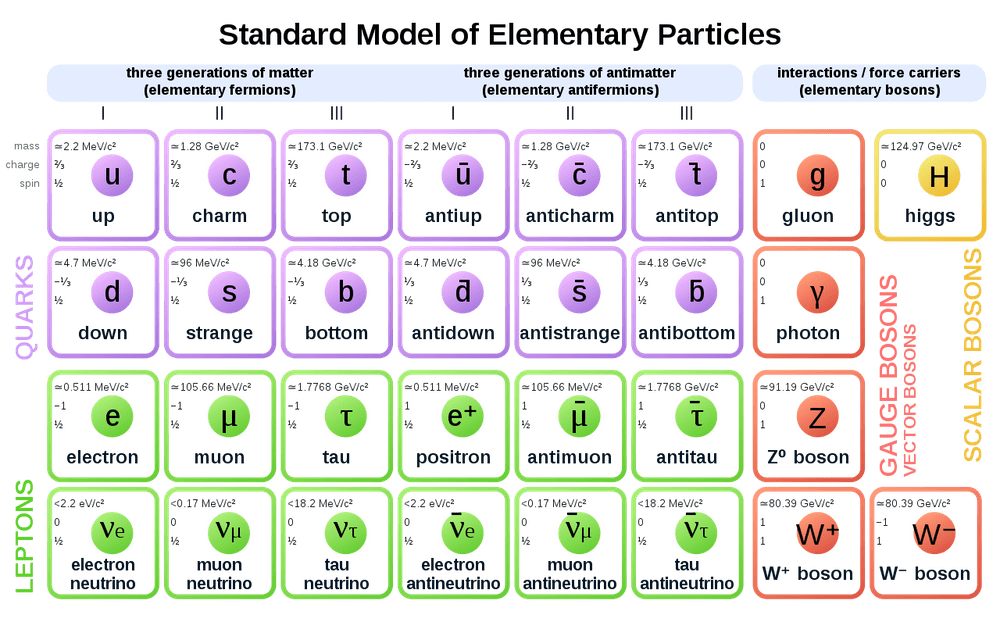
The properties of these particles are described in terms of mass, charge and spin within the atom. The behavior of these particles on a sub-atomic level is studied by physicists within the fields of quantum mechanics and particle physics. They have put together a model to explain how particles behave, which is called the Standard Model of Elementary Particles. Such behavior is described in very strange terms as you will notice above in the visual presentation. Most of this is way above my head, unfortunately. Richard Feynman, the late physicist who I probably admire the most, made great inroads in these fields and is said to have described quantum mechanics thus:
If you think you understand quantum mechanics, you don’t understand quantum mechanics.
Physicists study these particles in massive underground laboratories called colliders. Inside a typical particle collider, particles are accelerated at very high speeds and crashed into each other from opposite ends of the collider tunnels. The most famous of these particle colliders is CERN, the Large Hadron Collider, located on the France-Switzerland border in Europe.
It was here in 2012 that physicists finally discovered the particle during experiments, with the same properties described by Peter Higgs and his team in the 60’s. It was named the Higgs Boson. As I understand it, the Higgs particle has no mass of its own but imparts mass to other particles in the very very brief time it exists before dying or decaying as the scientists call it.
Physicist Leon Lederman cheekily nicknamed the Higgs Boson, the God Particle in his book of the same name. There is speculation that Lederman named it such, due to the heated arguments around how “something can be created from nothing” in the many Evolution/Creation debates raging around this time. It was a witty and very clever move because the Higgs Boson was supposed to be proof that mass could be created from nothing. It was soon thereafter that people started calling Peter Higgs the Father of the God Particle.
The average human body is composed of around seven billion billion billion atoms (7 000 000 000 000 000 000 000 000 000) or 7 x 10 to the power 27. Of those atoms carbon, hydrogen and oxygen make up 99% of the total atoms. Hydrogen is the major component, making up two thirds of that total of 99%.
Around 100 million years after the Big Bang is said to have spawned the universe, vast clouds of hydrogen and helium clumped together and collapsed under the force of their own gravity to form the first stars. Since our bodies are mostly hydrogen, we can conclude that we are made of the same material that formed the stars. Astrophysicist Carl Sagan famously said:
The cosmos is within us. We are made of star-stuff. We are a way for the universe to know itself.
This is where Peter Higgs is going. Back to the stars from whence he came. How very appropriate?
 lenny unencumbered